
AI has sped up content creation, but complicated questions around originality, authorship, accuracy and trust. Whether for customer-facing or internal use, businesses, educators, publishers and SEO teams are seeking a better way to vet content they suspect might be human-written, AI-generated, plagiarised or rewritten too closely from existing work.
Enter Winston AI. Here’s what Winston AI can do for you, how the Winston AI detector works, and where you can deploy it to help with content quality, SEO, Answer Engine Optimisation and Generative Engine Optimisation.
What Is Winston AI?
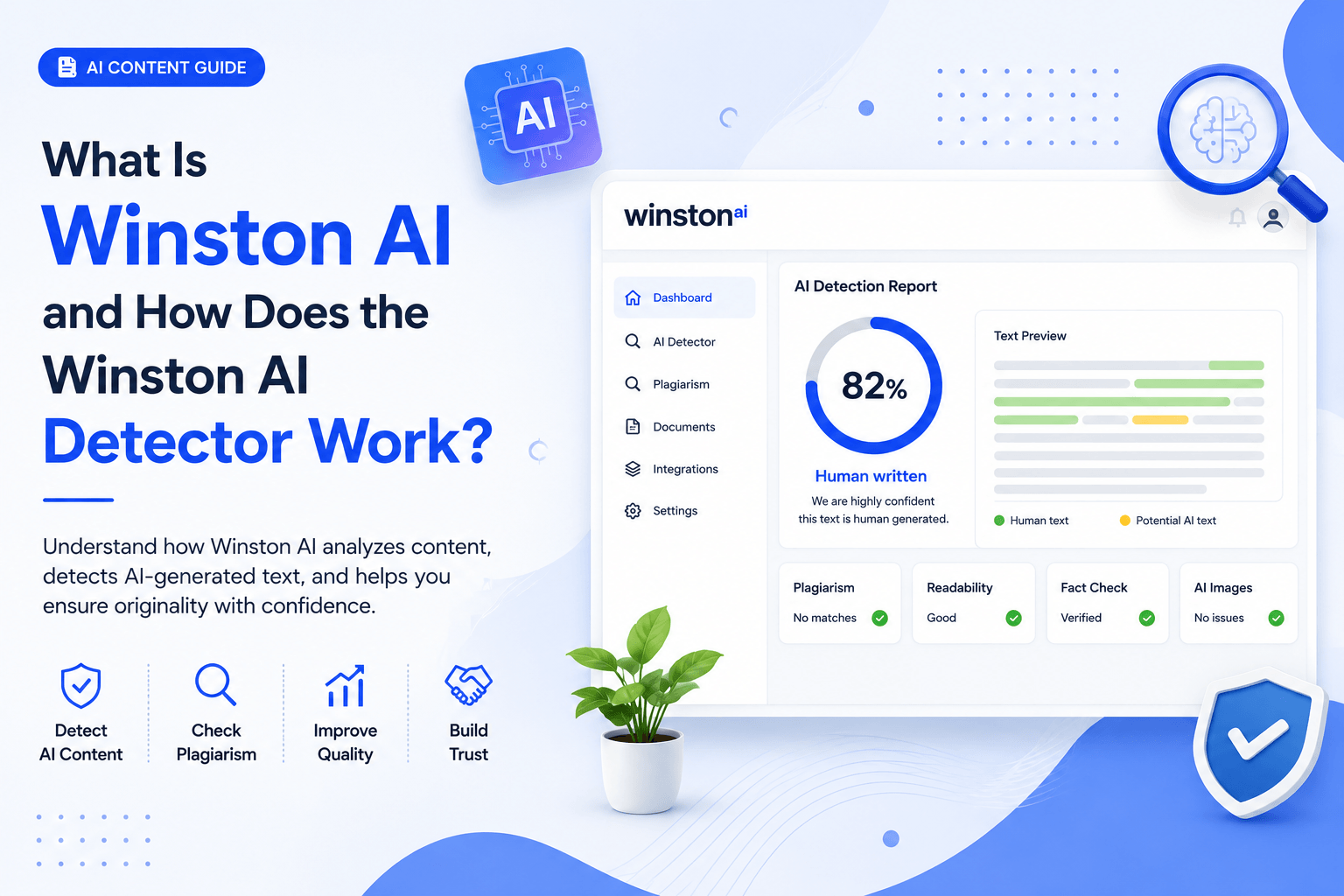
Winston AI detects AI-generated content and checks for originality. They analyze text to predict the likelihood that it was written by an AI or a human.
Additional features include plagiarism detection, writing improvement suggestions, readability scores, fact-checking, citation creation, grammar checks, and image recognition to detect AI-created images.
Simply paste your text, upload a file or enter a URL to have Winston analyze your content. Winston will give you a probabilistic output and mark areas that might be more predictable or bot-written.
How Does the Winston AI Detector Analyse Content?
The Winston AI Detector leverages machine learning and natural language processing to analyze text against patterns found in both human-written and AI-written material.
Some of the signals it may analyze include:
- Predictability of words and phrases
- Sentence structure and length
- Repetitive language patterns
- Consistency of tone
- Linguistic variation
- Similarities to known AI-generated content
The score is not meant to determine definitively who wrote the text. It’s an algorithm analyzing patterns. A high AI score indicates that the text more closely follows patterns commonly found in text generated by large language models. A high human score indicates the opposite.
What Features Does Winston AI Provide?
Features may include sentence-level highlighting, document uploading, URL importing, shareable reports, plagiarism detection, readability scores, writing suggestions, and other content-validation tools depending on the plan and scan type chosen by the user.
Editors can use these tools to review articles, agencies can use them to evaluate outsourced writing, and teachers can use them to assess student assignments.
The Winston AI detector scans for content produced by popular generative AI engines such as ChatGPT, Claude, and Google Gemini. Winston AI provides an API that can be integrated into existing content-management, publishing, or education-review platforms.
Is Winston AI Accurate Enough to Trust Completely?
AI detectors should not be used as a sole source of truth.
While Winston AI emphasizes a high degree of detection accuracy, AI detection is inherently probabilistic. External academic research as well as our own real-world testing has revealed that AI detection tools can at times yield false positives, fail to detect edited AI, or produce conflicting results on documents that contain both human and AI writing.
A Winston AI result should be the start of a review process, not the conclusion. In addition to AI detection results, editors, teachers, and organizations should review:
- Source notes and references
- Document revision history
- Factual accuracy
- Writing consistency
- Citation quality
- Previous work by the author
- The author’s research and drafting process
Editorial and professional judgment is still required, especially when a student, employee, writer, or content contributor is facing consequences.
Who Can Benefit From Using Winston AI?
People who may find Winston AI beneficial include teachers, universities, publishers, content agencies, website owners, editors, freelance writers, and internal marketing teams.
The tool can be particularly helpful when an organisation receives content from various authors and wants to ensure a consistent first-stage quality-control step.
SEO teams can use Winston AI to spot generic, repetitive, or highly predictable passages in need of deeper editing. That said, an AI score will not tell you if a page is helpful, credible, original or will rank on SERPs.
How Can Winston AI Support SEO, AEO, and GEO?
While Winston AI can aid with editorial review, it is not an SEO ranking factor tool.
Search engines reward content that fulfill users’ intent, provide helpful information, demonstrate applicable experience, and creates a positive page experience. AI-assisted content will not automatically be deemed low-quality content. Pages that are overly risky are those that have incorrect information, are copied/repeated across domains, unoriginal, and churned at scale with little to no added value.
Answer Engine Optimisation (AEO) should feature content that concisely answers a question right after a question-based heading. Key definitions, step list, comparisons, and takeaways should all be digestible by search engines, voice assistants, and users.
Generative Engine Optimisation (GEO) should ensure pages have sufficient accurate facts, identifiable entities, expert level context, clear organisation, and unique information that a generative search engine can trust to summarize or write about confidently.
Google’s guidance for publishers around generative search aligns with this and they’ve explicitly stated that core SEO, helpful content, technical accessibility, and unique first-hand experiences matter for visibility in generative search. In addition, Google has further stated they want to see no attempts to game their systems using undocumented AEO or GEO “hacks”.
Winston AI detector can be used as part of this workflow to help identify passages that may need editorial review. The editor should then look to enhance specificity, fact check information, include expert commentary, enhance examples, and remove non-committal passages. Editors should be focused on increasing usefulness, not hitting a certain detector score.
Why Should Businesses Combine Winston AI With a Broader SEO Strategy?
Content detection only solves one aspect of organic visibility. There’s also technical health, crawlable architecture, search intent mapping, internal linking, structured data, authoritative content creation, local relevance, and exceptional user experience.
Businesses that want to rank in competitive markets can partner with a professional SEO agency in Dubai to map content quality with technical SEO and connect it to AEO, GEO, local optimisation, and quantifiable search goals.
The correlation creates a much stronger foundation than implementing an AI detector as a reactive measure. The bundled SEO service touches on technical SEO, on-page optimisation, local SEO, international SEO, content strategy and also implements AEO and GEO optimisation.
How Should You Use the Winston AI Detector Responsibly?
Begin by checking entire documents instead of submitting only a few sentences for testing. Proofread flagged text, run originality checks, fact-check, and compare to the author’s other work.
Ask for research notes, source documents, outlines, or rough drafts if authorship matters.
Most importantly, don’t rewrite text just to “beat” an AI detector. Edit it to make it clearer, more accurate, original, expert, and valuable to your reader.
Can Winston AI Detect ChatGPT Content?
Winston AI detects the writing patterns common to ChatGPT and other leading AI models. Accuracy may be affected when content has been significantly edited, translated, paraphrased, or merged with human-written content.
Is Winston AI the Same as a Plagiarism Checker?
AI detection determines if text is likely machine-written. Plagiarism detection determines if text was copied from published sources. Winston AI offers both capabilities, which address separate questions when evaluating originality.
Does Google Penalise Content That Winston AI Flags?
Seeing a Winston AI flag does not indicate Google will penalise a page.
Google doesn’t use Winston AI scores to judge websites. Google’s systems reward helpful, trustworthy, people-first content. We may take action on scaled content that’s designed primarily to manipulate rankings, whether it was written by humans or AI.
Is Winston AI Worth Using?
SEO copywriters and content marketers often ask if Winston AI can be used to assess entire websites worth of content at once.
We built Winston AI to be one tool in your organisation’s toolkit. The best use case for Winston AI is as one data point in your broader editorial workflow. That workflow should always include human editorial judgement, fact checking, expert review, originality screening and a planned SEO strategy.
Used ethically, Winston AI can empower your content teams to defend originality and raise your content quality standards without deferring to an algorithm as gospel.